|
“Red wine stops effects of high-fat diet”, THE TELEGRAPH (UK) “Low doses of resveratrol keep you young at heart”, USA TODAY “New Hints Seen That Red Wine May Slow Aging”, NEW YORK TIMES “Red wine compound helps kill off cancer cells, new study finds”, LOS ANGELES TIMES |
All of you have read headlines like these, but have you ever heard of someone who actually lost weight, cured his heart problems, looked and felt younger and avoided chemotherapy, when he took one of the many currently available resveratrol supplements? You probably didn’t, right?
The Problem: More than 99% of the Orally Ingested Resveratrol Don’t Make it into Your Bloodstream
In the end, this is yet not very surprising. With a bioavailability scientist quantify as “considerably less than 1%” [1] more than 99% of the precious antioxidant in the average oral resveratrol supplement do not even make it into your bloodstream, because they are broken down or metabolized by the bacteria in your gut, the cells in your intestine, and of course your liver – the gatekeeper between the intestines and the general blood circulation.
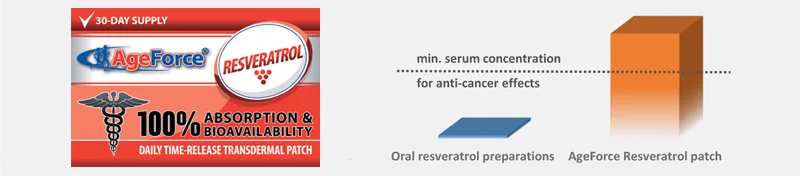
The obvious consequence: The maximal blood concentrations you can achieve with commercially available oral resveratrol preparations are 10-20x below the scientifically established minimum that would be required to trigger the heavily advertised cancer-protective effects [2].
The Solution: Age Force’s Brand-New Resveratrol Patch!
The pharmacological grade resveratrol in the brand-new Resveratrol Patches is delivered through the skin right into the blood stream. Practically speaking, this means
- no enzymatic breakdown and conversion into inactive metabolites in gut and liver
- maximal absorption and unparalleled bioavailability
- up to 70x higher serum levels of intact resveratrol molecules compared to oral preparations
What’s even more important, though, is the fact that the intact resveratrol molecules can now finally do what you’d expect from any resveratrol supplement: Defend your organs against free radicals & oxidative damage[3],[4], improve your glucose [3],[5] & lipid metabolism [6], strengthen and rejuvenate your mitochondria [7],[8],[9], help you win the battle against Alzheimer’s [10][11], guard your DNA [12] and protect [13] and help cure cancer [14].
References:
[1] Walle, Thomas. “Bioavailability of resveratrol.” Annals of the New York Academy of Sciences 1215.1 (2011): 9-15.
[2] Boocock, D. J., Faust, G. E., Patel, K. R., Schinas, A. M., Brown, V. A., Ducharme, M. P., … & Brenner, D. E. (2007). Phase I dose escalation pharmacokinetic study in healthy volunteers of resveratrol, a potential cancer chemopreventive agent. Cancer Epidemiology Biomarkers & Prevention, 16(6), 1246-1252.
[3] Sebai, Hichem, et al. “Cardioprotective effect of resveratrol on lipopolysaccharide-induced oxidative stress in rat.” Drug and Chemical Toxicology 34.2 (2011): 146-150.
[4] Martıń , Antonio Ramón, et al. “Resveratrol, a polyphenol found in grapes, suppresses oxidative damage and stimulates apoptosis during early colonic inflammation in rats.” Biochemical pharmacology 67.7 (2004): 1399- 1410.
[5] Crandall, Jill P., et al. “Pilot study of resveratrol in older adults with impaired glucose tolerance.” The Journals of Gerontology Series A: Biological Sciences and Medical Sciences 67.12 (2012): 1307-1312.
[6] Ahn, Jiyun, et al. “Dietary resveratrol alters lipid metabolism-related gene expression of mice on an atherogenic diet.” Journal of hepatology 49.6 (2008): 1019-1028.
[7] Lagouge, Marie, et al. “Resveratrol improves mitochondrial function and protects against metabolic disease by activating SIRT1 and PGC- 1α.” Cell 127.6 (2006): 1109-1122.
[8] Denu, John M. “Fortifying the Link between SIRT1, Resveratrol, and Mitochondrial Function.” Cell metabolism 15.5 (2012): 566-567.
[9] Ungvari, Zoltan, et al. “Mitochondrial protection by resveratrol.” Exercise and sport sciences reviews 39.3 (2011): 128.
[10] Anekonda, Thimmappa S. “Resveratrol—A boon for treating Alzheimer’s disease?.” Brain Research Reviews 52.2 (2006): 316-326.
[11] Chang, Jaewon, et al. “Low-dose pterostilbene, but not resveratrol, is a potent neuromodulator in aging and Alzheimer’s disease.” Neurobiology of aging 33.9 (2012): 2062-2071.
[12] Bisht, Kavita, Karl-Heinz Wagner, and Andrew C. Bulmer. “Curcumin, resveratrol and flavonoids as anti-inflammatory, cyto-and DNA-protective dietary compounds.” Toxicology 278.1 (2010): 88-100.
[13] Shukla, Yogeshwer, and Richa Singh. “Resveratrol and cellular mechanisms of cancer prevention.” Annals of the New York Academy of Sciences 1215.1 (2011): 1-8.
[14] Aires, Virginie, et al. “Resveratrol metabolites inhibit human metastatic colon cancer cells progression and synergize with chemotherapeutic drugs to induce cell death.” Molecular nutrition & food research (2013).
New Health & Fitness News
- Resveratrol
- Melatonin – It’s A Lot More Than Just A Good Night’s Sleep
- Can Consuming Fat Help An Athlete Achieve Peak Performance?
- Medicines Made in India (And China) Set Off Safety Worries
- Omega-3 For Mental And Physical Health
- Exercising for Healthier Eyes
- Creatine Research Could Change Sports Nutrition
- The Advantages Of Transdermal Delivery
- Allergy Relief Patch Coming In April
- Exercises to Strengthen Bones
- The Advantages Of Transdermal Resveratrol