The bioavailability advantage of transdermal delivery
Convenience, efficacy and safety – three of many good reasons to go transdermal
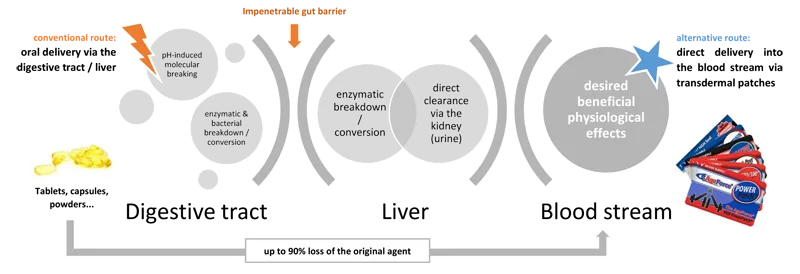
When we ingest supplements or medications, few of us will think about the various hurdles the active ingredients in the caps, pills or powders have to pass before they finally make it into our bloodstream – a common mistake, as the following elaborations are about to show.
It is after all by no means self-evident that the active ingredients in the various capsules, pills and powders many of us are consuming on a daily basis will survive the
- the extreme pH changes in the stomach, small and large intestine,
- the billions of insatiable bacteria which guard your intestines, and
- the impenetrable gut immune barrier, which constitutes a “first line of defense” against intruders.
Due to acid-induced breaking of the molecular structure, enzymatic conversion of a biologically active to an inactive form of a certain molecule and the insatiable hunger of billions of your biotic gut tenants, large amounts of the expensive supplements and medications you are taking are disassembled, modified or lost before they even get a chance to pass the gut barrier and enter the portal vein.
The latter will transport them to the liver which acts as a gate-keeper that prevents foreign bioactive compound from entering the bloodstream. Popular supplements like resveratrol supplement or curcumin, dietary xanthines and polyphenols like caffeine or EGCG (green tea) and hormonal substances such as diiodothyronine (thyroid hormone T2), DHEA supplement, DHEA & 7- Keto, they all have to survive what scientist call the “first pass”.
In that, the term “fist pass” is used as an umbrella term for a complex metabolic process at the end of which many only a small amount of active drug is released by the liver into the circulatory system. The corresponding “loss” of active ingredients can range from a few percent as in caffeine to levels of 90% or more as it has been observed for resveratrol, where only trace amounts of an orally administered supplement actually made it into the blood stream of the healthy volunteers in a 2004 study by (Walle. 2004). Against that background it’s hardly surprising that many of the promising results researchers observed in animal models in response to the injection of resveratrol and/or other supplements with low oral bioavailability1 cannot be reproduced with either, pills, powders or capsules.
The transdermal solution to the oral bioavailability issue
This is where our innovative patch technology comes into play. With its unique ability to breach the protective barrier of the skin, it will shuttle the active ingredients of our patches right into your bloodstream, where they will begin to unfold their individual health and performance benefits before your liver can get a hold of them.
For agents with a very low bioavailability like resveratrol, curcumin & co transdermal delivery may be the only valid alternative to injections.
For others, it will increase the relative potency2 of a given supplement or drug (e.g. caffeine, diiodothyronine (T2), etc.) and reduce unwanted side effects due to metabolic byproducts that form in the gut or liver during the absorption process (e.g. l-canitine ➪ trimethylamine N-oxide, a purported contributor to heart disease risk; see Koeth. 2013).
Transdermal advantages
Next to the previously discussed improved bioavailability kinetics (Cleary 1993; Henzel. 2003; Kornick. 2003), Marc B. Brown and his colleagues from the King’s College in London highlight the following benefits of transdermal / cutaneous drug delivery:
- Sustained and controlled delivery over a prolonged period of time (Varvel. 1989; Yang. 2004).
- Reduction in side effects associated with systemic toxicity i.e., minimization of peaks and troughs in blood-drug concentration (Cramer. 1994; Kornick. 2003).
- Improved patient acceptance and compliance (Payne. 1998; Jarupanic. 2003; Archer. 2004).
- Direct access to target or diseased site, e.g., treatment of skin disorders such as psoriasis, eczema, and fungal infections (Colin Long 2002).
- Ease of dose termination in the event of any adverse reactions either systemic or local.
- Convenient and painless administration (Cleary. 1993; Henzel. 2003).
- Ease of use may reduce overall health care treatment costs (Whittington. 1995; Frei. 2003).
- Provides an alternative in circumstances where oral dosing is not possible (in unconscious or nauseated patients) (Kornick. 2003).
It’s thus actually not surprising that the big drug developing companies have long realized that the skin is the drug delivery route of the future (see Figure 1).
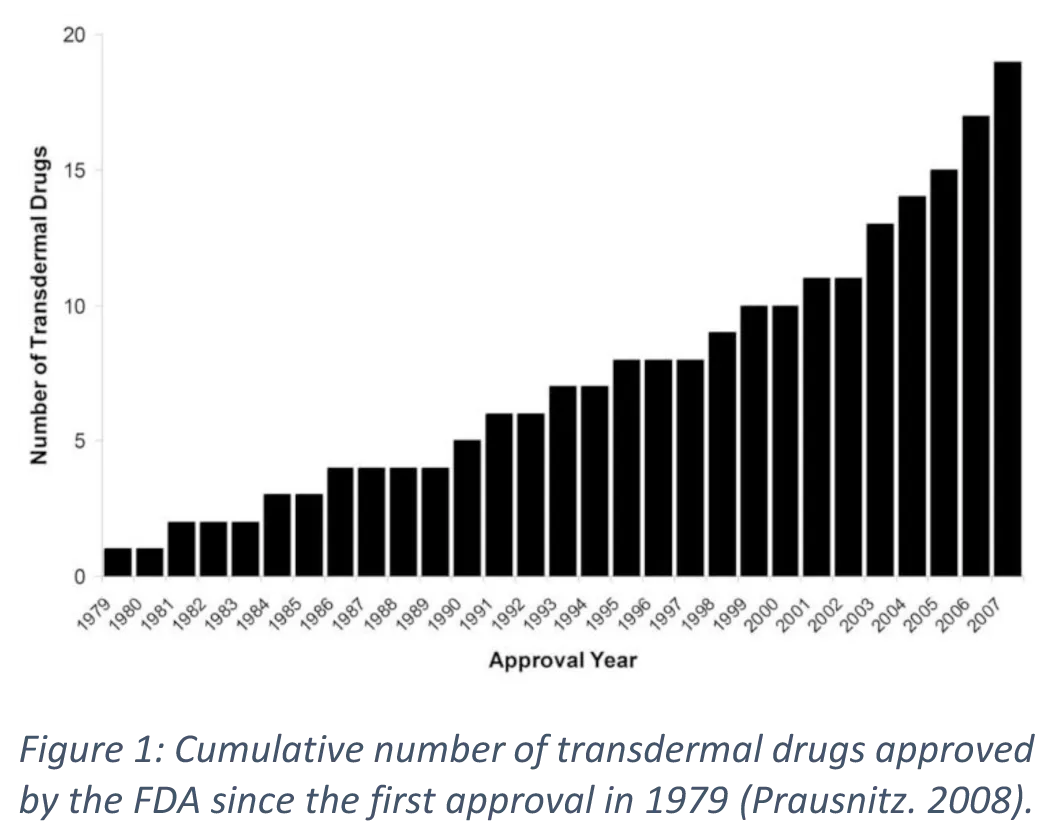
Still, experts like Mark R. Prausnitz from the School of Chemical and Biomolecular Engineering, Georgia Institute of Technology in Atlanta believe that the technological advances of the past decade leave no doubt that “transdermal drug delivery has only scratched the surface of possible clinical impact” (Prausnitz. 2004) – an impact of which other experts say that it will reverberate in the everincreasing market of dietary supplements, as well.
References:
Archer, David F., et al. “The impact of improved compliance with a weekly contraceptive transdermal system (Ortho Evra®) on contraceptive efficacy.” Contraception 69.3 (2004): 189-195.
Brown, Marc B., et al. “Dermal and transdermal drug delivery systems: current and future prospects.” Drug delivery 13.3 (2006): 175-187.
Cleary, Gary W. “Transdermal delivery systems: a medical rationale.” Topical Drug Bioavailability, Bioequivalence, and Penetration. Springer US, 1993. 17-68.
Henzl, Milan R., and Preeti K. Loomba. “Transdermal delivery of sex steroids for hormone replacement therapy and contraception. A review of principles and practice.” The Journal of reproductive medicine 48.7 (2003): 525-540.
Jarupanich, Tapnarong, Surachai Lamlertkittikul, and Verapol Chandeying. “Efficacy, safety and acceptability of a seven-day, transdermal estradiol patch for estrogen replacement therapy.” Journal of the Medical Association of Thailand= Chotmaihet thangphaet 86.9 (2003): 836-845.
Koeth, Robert A., et al. “Intestinal microbiota metabolism of l-carnitine, a nutrient in red meat, promotes atherosclerosis.” Nature medicine 19.5 (2013): 576-585.
Kornick, Craig A., et al. “Benefit-risk assessment of transdermal fentanyl for the treatment of chronic pain.” Drug Safety 26.13 (2003): 951-973.
Payne, Richard, et al. “Quality of life and cancer pain: satisfaction and side effects with transdermal fentanyl versus oral morphine.” Journal of clinical oncology 16.4 (1998): 1588-1593.
Prausnitz, Mark R., Samir Mitragotri, and Robert Langer. “Current status and future potential of transdermal drug delivery.” Nature Reviews Drug Discovery 3.2 (2004): 115-124.
Prausnitz, Mark R., and Robert Langer. “Transdermal drug delivery.” Nature biotechnology 26.11 (2008): 1261- 1268.
1. The term Bioavailability quantifies the fraction of an administered dose of unchanged drug that reaches the systemic circulation.
2. The term relative potency is used to refer to the effect size generated by a certain amount of a drug / supplement. If the relative potency of a given substance increases by factor 10x, for example, customers will see the same results with 10mg from a transdermal product as they would see from 100mg oral preparation.
New Health & Fitness News
- Resveratrol
- Melatonin – It’s A Lot More Than Just A Good Night’s Sleep
- Can Consuming Fat Help An Athlete Achieve Peak Performance?
- Medicines Made in India (And China) Set Off Safety Worries
- Omega-3 For Mental And Physical Health
- Exercising for Healthier Eyes
- Creatine Research Could Change Sports Nutrition
- The Advantages Of Transdermal Delivery
- Allergy Relief Patch Coming In April
- Exercises to Strengthen Bones
- The Advantages Of Transdermal Resveratrol